loading ...
Physics news 1234

Invisible Waves Shape Continental Slope, Researcher Says

June 30, 2008 | User rating: 3.8 / 5 after 17 vote(s) | No comments yet

A class of powerful, invisible waves hidden beneath the surface of the ocean can shape the underwater edges of continents and contribute to ocean mixing and climate, researchers from The University of Texas at Austin have ...


New technology may help Olympic sailing

June 30, 2008 | User rating: 4.2 / 5 after 6 vote(s) | No comments yet

A team of researchers at the Ocean University of China has developed and tested a mobile lidar (light detection and ranging) station that can accurately measure wind speed and direction over large areas in real time -- an ...


Could better spin injection lead to a quantum information device?

June 30, 2008 | User rating: 4.3 / 5 after 19 vote(s) | No comments yet

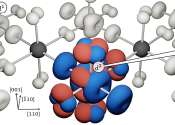
One of the more promising types of materials for use in spintronics today is the class of metal alloys known as Heusler alloys. These alloys are named after a German engineer, and might be useful in technology in which electron ...


Chasing rainbows

June 27, 2008 | User rating: 4.3 / 5 after 12 vote(s) | No comments yet

Engineers working in optical communications bear more than a passing resemblance to dreamers chasing rainbows. They may not wish literally to capture all the colors of the spectrum, but they do seek to control the rate at ...


Researchers create mercury-absorbent container linings for broken CFLs

June 27, 2008 | User rating: 4.5 / 5 after 19 vote(s) | User comments: 22

With rising energy prices and greater concern over global warming, compact fluorescent lamps (CFLs) are having a successful run. Sales of the curlicue, energy-sipping bulbs, which previously had languished ...


Oxygen Ions for Fuel Cells Get Loose at Low Temperatures

June 25, 2008 | User rating: 4.2 / 5 after 28 vote(s) | No comments yet

Seeking to understand a new fuel cell material, a research team working at the National Institute of Standards and Technology (NIST), in collaboration with the University of Liverpool, has uncovered a novel ...


Silicon photonic crystals key to optical cloaking

June 25, 2008 | User rating: 4.5 / 5 after 43 vote(s) | User comments: 8

In computer simulations, the researchers have demonstrated an approximate cloaking effect created by concentric rings of silicon photonic crystals. The mathematical proof brings scientists a step closer to a practical solution ...


Laser fluorescence could find life on Mars

June 23, 2008 | User rating: 4.3 / 5 after 10 vote(s) | No comments yet

A team of scientists from the United States and the United Kingdom has developed a technique using ultraviolet light to identify organic matter in soils that they say could be used to document the existence of life on Mars.


A novel X-ray source could be brightest in the world

June 20, 2008 | User rating: 4.4 / 5 after 25 vote(s) | User comments: 2

Oscillator projected to increase current brightness by millions of times
The future of high-intensity x-ray science has never been brighter now that scientists at U.S. Department of Energy's Argonne National Laboratory ...


Exciton-based circuits eliminate a 'speed trap' between computing and communication signals

June 19, 2008 | User rating: 4.7 / 5 after 20 vote(s) | User comments: 3

Particles called excitons that emit a flash of light as they decay could be used for a new form of computing better suited to fast communication, physicists at UC San Diego have demonstrated.


NIST/NIH micromagnets show promise as colorful 'smart tags' for magnetic resonance imaging

June 18, 2008 | User rating: not shown ( 1 vote(s) ) | No comments yet

Colo.-Customized microscopic magnets that might one day be injected into the body could add color to magnetic resonance imaging (MRI), while also potentially enhancing sensitivity and the amount of information ...


Scientists discover that protons partner with neutrons more often than with other protons

June 18, 2008 | User rating: 4 / 5 after 24 vote(s) | User comments: 6

Fast-moving protons are much more likely to pair up with fast-moving neutrons than with other protons in the nuclei of atoms, according to a recent experiment performed at the U.S. Department of Energy's Thomas ...


Developing better nano-electronics by understanding nonadiabatic effects

June 17, 2008 | User rating: 4.3 / 5 after 24 vote(s) | User comments: 2

“Basically,” Michele Lazzeri tells PhysOrg.com, “the Born-Oppenheimer adiabatic approximation tells us how atoms are vibrating.” This adiabatic effect is used to describe phonons, which are modes of vibration that ...


Scientists model molecular switch

June 16, 2008 | User rating: 4.7 / 5 after 15 vote(s) | User comments: 2

Michigan Technological University physicist Ranjit Pati and his team have developed a model to explain the mechanism behind computing's elusive Holy Grail, the single molecular switch.


World's Largest Quantum Bell Test Spans Three Swiss Towns

June 16, 2008 | User rating: 4.7 / 5 after 114 vote(s) | User comments: 21

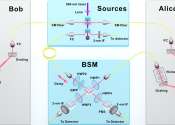
In an attempt to rule out any kind of communication between entangled particles, physicists from the University of Geneva have sent two entangled photons traveling to different towns located 18 km apart – ...


Pages: 1 2 Next »